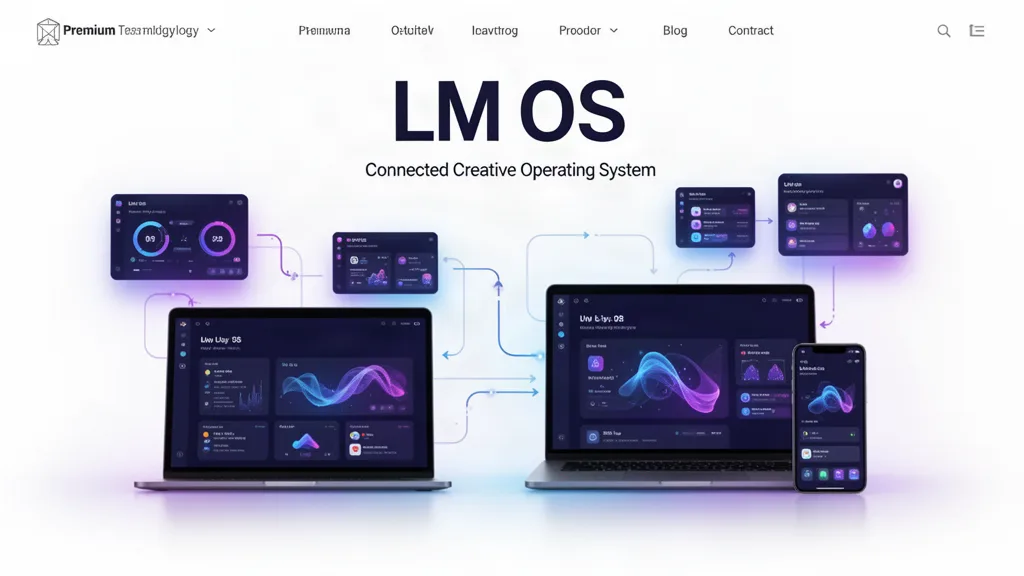
LMOS VOID Beta 0.34.4: Every App Gets a Business, Product, and Learning Review
LMOS now has a scheduled software-review doctrine across the whole app portfolio: daily operating sweeps, weekly all-app reviews, monthly commercial reviews, quarterly portfolio decisions, and explicit post-release/post-issue learning rules.
The twelve review laws
Revenue proves commercial value: commercially launched products must eventually earn money or show a credible paid-value path.
Execution beats the idea: review the experience people actually receive.
Manage people, not just tickets: every important product needs clear human ownership and capacity.
Not everyone is the customer: learn from repeated target-customer pain without chasing every preference.
Trust informed instincts: combine experienced judgment with evidence rather than replacing either one.
Do what LM does best: build distinctive value; integrate or partner for commodity layers when appropriate.
Good things take time: patience is valid when each cycle produces learning or improvement.
Failure is instruction: fix the cause and preserve the lesson.
Inspire great work: clarity, purpose, trust and standards are leadership responsibilities.
Customer issues become product intelligence: support and beta friction should improve the product system.
Familiar before distinctive: users should understand the first move before LM asks them to learn something new.
LMOS is the operating layer: one identity, project graph, files, windows, collaboration, business operations, developer path and App Store.
Faith-centered positioning
The review mission positions LMOS positively as a faith-centered, world-class alternative to mainstream software ecosystems, open to people and organizations who value the approach. Christian conviction should be expressed through stewardship, honesty, dignity, service, excellence and care—not by demeaning people who choose other software.
What the scheduled reviews inspect
Every current LM app rather than a hand-picked subset.
Active access, projects and followers as adoption signals.
Open feedback, issues and beta friction.
Open build work and high-priority work.
App review patterns where evidence exists.
Certification evidence and blocked QA gates.
Direct paid subscriptions during commercial reviews, while keeping LMOS bundle value portfolio-level.
Quarterly disposition decisions: double down, continue, integrate/partner, simplify, pause, or stop.
What testers should try
Open LM Control Center and expand LM Software Review Law.
Confirm all twelve principles have a concrete review question rather than a slogan alone.
Confirm daily, weekly, monthly, quarterly, per-release and post-issue cadences are visible.
Use Run full loop to queue the evidence sweep and scheduled-review baselines.
Check later review reports for per-app evidence and findings instead of a generic portfolio score.
Use the beta on real work.
The most useful feedback is not “I like it.” Tell us where you hesitated, what took too many clicks, what did not save the way you expected, and what would make this useful enough to return to next week.